


Managing diabetes is already hard. Not knowing if your insulin still works makes it even harder.
We've got you.


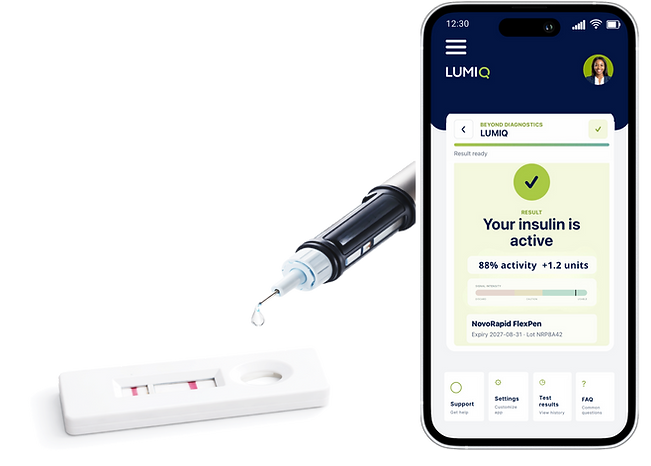

Trusting insulin shouldn’t be blind.
Everyday factors like heat, handling, and time silently affect insulin’s quality and as patients, we have no way to know if it still works.
LUMIQ tells you if your insulin is working as it should.
We are currently developing your future insulin quality test. Available for the first test cohort 2027.

Featured.

Moments when it counts.
Away from home
Before the night
When questions remain


How it works.
Apply one drop
You inject a unit of insulin on the test.
Capture the signal
The strip reacts and creates a line related to the quality.
Check it with the app
Your smartphone camera and our AI read the lines and translate them into an easy to understand estimate of remaining insulin quality.
Get a clear answer
You see a percentage of activity and clear indication of insulin usability.

What this means for you.
-
More confidence in your insulin
-
Fewer “why is nothing working?” moments
-
A way to check before you inject
-
Less fear when something feels off
Powered by advanced sensing and intelligent data interpretation using your smartphone camera.

Where innovation meets molecular biology.
Our journey began within the Insulin Activity Lab at the Diabetes Center Berne, where we developed innovative methods to assess real-time insulin quality.
Science built with patients not around them.

Insulin activity in everyday life
Experiences reported by people with type 1 diabetes, including challenges with storage and travel.
Hanne Ballhausen, Lutz Heinemann & Maren Schinz
Journal of Diabetes Science and Technology · 2026
For people living with type 1 diabetes, insulin is essential - but keeping it at the right temperature can be challenging. A multinational survey found that nearly one in three people (32%) had experienced difficulties storing insulin while travelling, while 28% reported heat-related incidents. Everyday situations such as travel, hot weather, or leaving insulin in a warm environment can make proper storage challenging. These findings highlight a practical issue that can easily be overlooked: insulin needs to work in the real world, not just under ideal storage conditions. The study underscores the need for clearer guidance and practical solutions to help people with diabetes protect their insulin from heat and maintain its effectiveness wherever and whenever.
Insulin, temperature and the real world
What research tells us about insulin stability and where real-world evidence is still needed.
Lutz Heinemann, Stefanie Dobitz & Maren Schinz
Journal of Diabetes Science and Technology · 2026
For people who rely on insulin to manage their diabetes, keeping their insulin at the right temperature is an important part of everyday life. But insulin can be exposed to heat, cold, or physical stress during travel, at home, outdoors, or while being transported. As the world gets warmer, these challenges are becoming increasingly important - particularly for people living in hot climates or places where reliable refrigeration is not always available. Our review explores what happens to insulin when it is exposed to temperatures outside the recommended range. Although we know from laboratory studies that temperature can affect insulin, we still have much to learn about what happens in real-life situations. Better understanding of these effects will help people with diabetes store and use their insulin safely, improve guidance, and support access to effective insulin in a changing climate.
OUR CORE TEAM.

Dr. Stefanie Dobitz

Daniel Tobler

Dr. Maren Schinz

Danai Kokona
OUR awesome ADVISORY BOARD.

Prof. Lutz Heinemann

Prof. Katarina Braune

Prof. Dominik Meinel

Bridget Mcnulty

Hanna Böethius

Nupur Lavani
FAQ.
Is there a way to test whether my insulin is still good after it got hot?
Today, there is no widely available consumer test that directly measures insulin quality at the point of use. Patients typically rely on manufacturer storage recommendations, visual inspection, and glucose responses to assess whether insulin may have been compromised. LUMIQ is being developed by Beyond Diagnostics to address this unmet need by enabling point-of-care medication quality verification. References American Diabetes Association (ADA): Standards of Care in Diabetes U.S. FDA: Information Regarding Insulin Storage and Switching Between Products Hövelmann et al., "Insulin Stability in Real-World Use", Journal of Diabetes Science and Technology Heinemann L. et al., Studies on insulin degradation and temperature exposure
Can insulin lose effectiveness without looking different?
Yes. Scientific studies have shown that insulin may undergo structural and functional changes before obvious visual changes become apparent. As a result, insulin can potentially lose biological activity while appearing unchanged. References Kerr et al., Journal of Pharmaceutical Sciences Heinemann et al., Journal of Diabetes Science and Technology Novo Nordisk Storage Recommendations Sanofi Insulin Handling Guidance
What happens when insulin gets too hot?
Insulin is a protein-based medicine. Elevated temperatures may accelerate degradation processes that can affect biological activity and treatment performance. The extent of degradation depends on: - Temperature - Duration of exposure - Insulin formulation - Handling conditions References World Health Organization (WHO) Technical Report Series FDA Storage Recommendations Vimalavathini & Gitanjali (2009) Effects of Temperature on Insulin Potency Heinemann et al. (2021)
Can insulin be damaged during travel?
Yes. Travel can expose insulin to: - Excessive heat - Freezing temperatures - Direct sunlight - Uncontrolled storage conditions This is one reason diabetes organizations recommend appropriate cooling and storage solutions when travelling. References International Diabetes Federation (IDF) CDC Traveling with Diabetes ADA Travel Recommendations
Can I check my insulin’s quality at home?
That’s exactly what we’re building LUMIQ for: a simple insulin quality test you can use yourself. It started with a question our founder Maren asked while living with type 1 diabetes: “Why can’t I just check my insulin?” Today, we’re turning that question into a test. Join our waiting list to help shape what comes next.
What is LUMIQ?
LUMIQ is an insulin quality test we’re developing to help people check their insulin before using it. Our goal is to make that check simple enough for everyday life.
Can I buy a LUMIQ test yet?
Not yet. LUMIQ is still in development. You can join our waiting list to receive updates and hear about opportunities to take part in future product testing.
Why are you developing an insulin quality test?
Our founder Maren lives with type 1 diabetes. She kept wondering why there wasn’t a simple way to check whether her insulin was still working as expected. That personal question became the starting point for research at the Diabetes Center Berne — and for LUMIQ.
What happens when I join the waiting list?
You’ll receive updates about LUMIQ’s development. We may also invite you to share your experiences or take part in future product testing. Joining is free, and there is no obligation to buy.
SUPPORTED BY.


IN COLLABORATION WITH


GRANTS & AWARDS


